将此段图片转文字可以直接粘贴
中心动态


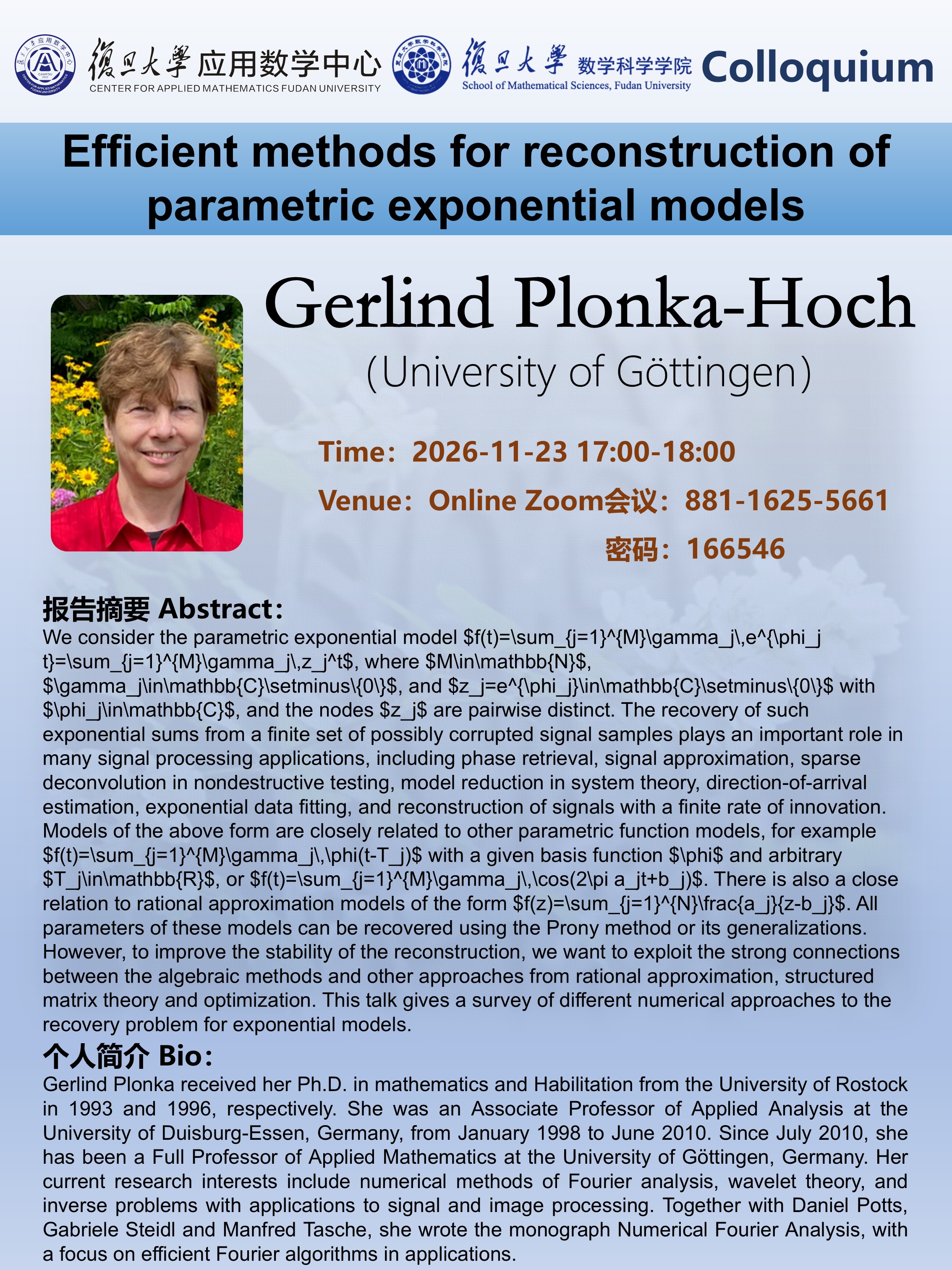
报告题目 Title:Efficient methods for reconstruction of parametric exponential models
报告人 Speaker:Gerlind Plonka-Hoch
报告人所在单位 Affiliation:University of Göttingen
时间 Time:2026-11-23 17:00-18:00
地点 Venue:Online Zoom会议:881-1625-5661 密码:166546
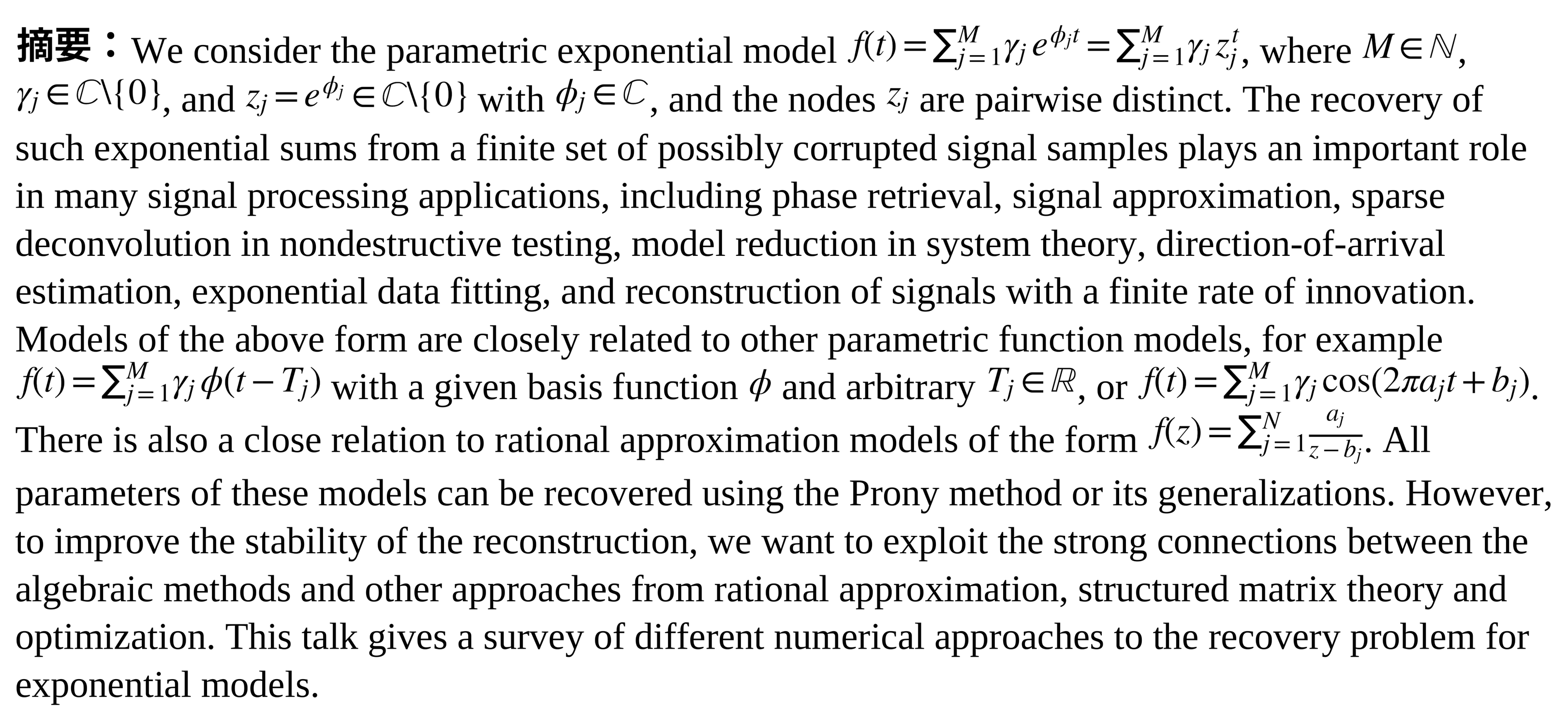
报告摘要 Abstract:We consider the parametric exponential model $f(t)=\sum_{j=1}^{M}\gamma_j\,e^{\phi_j t}=\sum_{j=1}^{M}\gamma_j\,z_j^t$, where $M\in\mathbb{N}$, $\gamma_j\in\mathbb{C}\setminus\{0\}$, and $z_j=e^{\phi_j}\in\mathbb{C}\setminus\{0\}$ with $\phi_j\in\mathbb{C}$, and the nodes $z_j$ are pairwise distinct. The recovery of such exponential sums from a finite set of possibly corrupted signal samples plays an important role in many signal processing applications, including phase retrieval, signal approximation, sparse deconvolution in nondestructive testing, model reduction in system theory, direction-of-arrival estimation, exponential data fitting, and reconstruction of signals with a finite rate of innovation. Models of the above form are closely related to other parametric function models, for example $f(t)=\sum_{j=1}^{M}\gamma_j\,\phi(t-T_j)$ with a given basis function $\phi$ and arbitrary $T_j\in\mathbb{R}$, or $f(t)=\sum_{j=1}^{M}\gamma_j\,\cos(2\pi a_jt+b_j)$. There is also a close relation to rational approximation models of the form $f(z)=\sum_{j=1}^{N}\frac{a_j}{z-b_j}$. All parameters of these models can be recovered using the Prony method or its generalizations. However, to improve the stability of the reconstruction, we want to exploit the strong connections between the algebraic methods and other approaches from rational approximation, structured matrix theory and optimization. This talk gives a survey of different numerical approaches to the recovery problem for exponential models.
个人简介 Bio:Gerlind Plonka received her Ph.D. in mathematics and Habilitation from the University of Rostock in 1993 and 1996, respectively. She was an Associate Professor of Applied Analysis at the University of Duisburg-Essen, Germany, from January 1998 to June 2010. Since July 2010, she has been a Full Professor of Applied Mathematics at the University of Göttingen, Germany. Her current research interests include numerical methods of Fourier analysis, wavelet theory, and inverse problems with applications to signal and image processing. Together with Daniel Potts, Gabriele Steidl and Manfred Tasche, she wrote the monograph Numerical Fourier Analysis, with a focus on efficient Fourier algorithms in applications.
海报 Poster:  Gerlind Plonka-Hoch 学术海报.jpg

电话 Tel:021-65648958
邮箱 Email:am_admin@fudan.edu.cn
地址 Address:上海市杨浦区湾谷科技园二期D1栋
Building D1, Bay Valley II, Yangpu District, Shanghai, China
邮编 Postcode:200438